
I’ve always been impressed with Jason Perz’s ability to stay true to his trading system.
As our resident energy/macro trader, he is perhaps more exposed to headline risk than anyone else I know.
Personally, I couldn’t imagine having to deal with a new ceasefire/no ceasefire headline every other weekend and then seeing my energy trades gapped up/down as a result.
Then again, Jason’s a pro. So he’s probably used to this.
Jason came on The Morning Show today to talk about the part of the energy trade that most intrigues him right now—the oil refiners.
Look how strong this group has been.
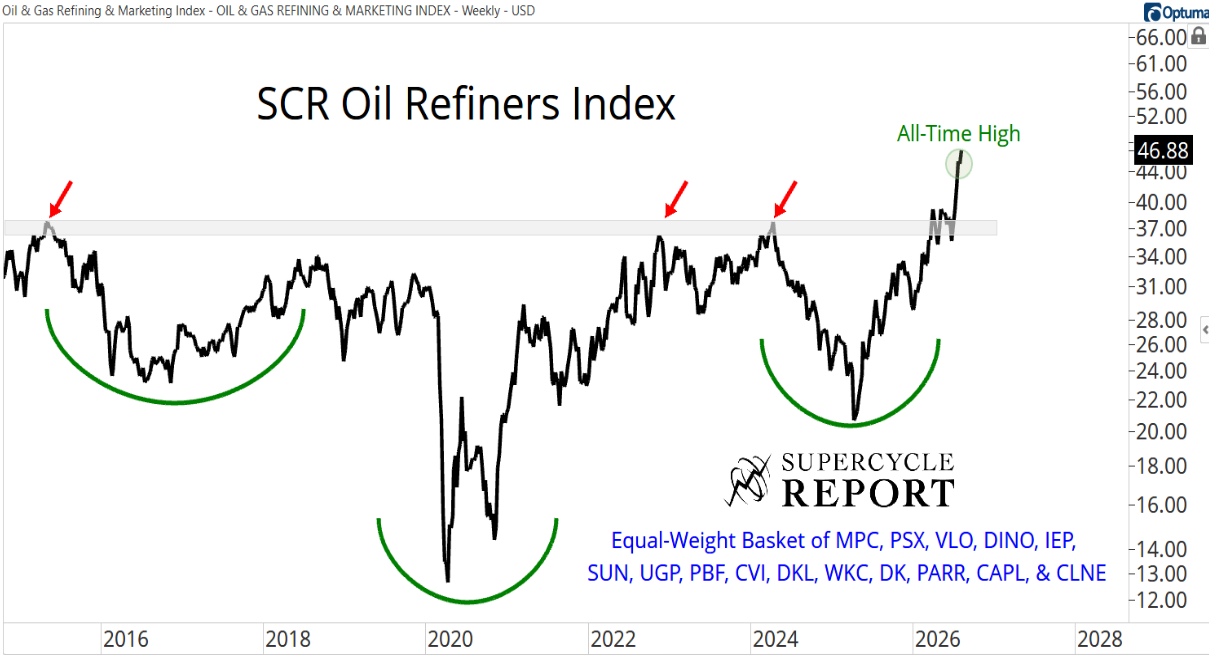
Refiners are the strongest group in energy over 12 months. And six months. And three months. And one month. And year to date.
Why? The mechanism is the crack spread, which is the gap between what a refiner pays for crude and what it sells gasoline, heating oil and jet fuel for. Oil is not going up nearly as much as the refined products are, and that gap is where refiners get paid.
Jason explained this trade in much more detail on today’s show.
– Spencer
P.S. The refiner trade is only one part of Jason’s long-term energy thesis. He’s got a lot more where that came from. And Thursday afternoon, he’s going live to reveal his top ideas. The stream is free, but it won’t be on Youtube. RSVP here.
This invitation appeared in the August 5, 2026 issue and refers to the August 6, 2026 event.
Questions and answers
#From the August 5, 2026 Daily Rundown.
What is the crack spread in the refiner discussion?
It is the gap between the cost of crude oil and the prices refiners receive for products such as gasoline, heating oil and jet fuel. Spencer uses it to explain why refined-product prices rising faster than crude could improve the economics of refining.
Why can refiners strengthen even when the crude-oil headline looks weak?
Their business depends on the relationship between input and output prices, not crude alone. In the August 5 discussion, refined products were outperforming oil, widening the gap that interested Perz. That made refiners a distinct energy exposure rather than a simple bet on higher crude prices.
Originally published by Spencer Israel.