
Confession: Bond market talk usually makes my eyes glaze over.
I know that the bond market is important, and I admire people like JC and Jason for their perpetual commitment to caring about it, but it’s basically my least favorite subject in markets school.
At least, it was until recently. The parabolic move in global yields has even me interested. That’s why I want to highlight what JC said today on The Morning Show.
It starts with credit spreads, the extra yield bond buyers demand in order to loan money to riskier companies instead of the U.S. government. When investors get scared, those spreads blow out (i.e., get wider).
JC walked us through the relationships with this chart. There’s a lot going on, so I’ll break it down.
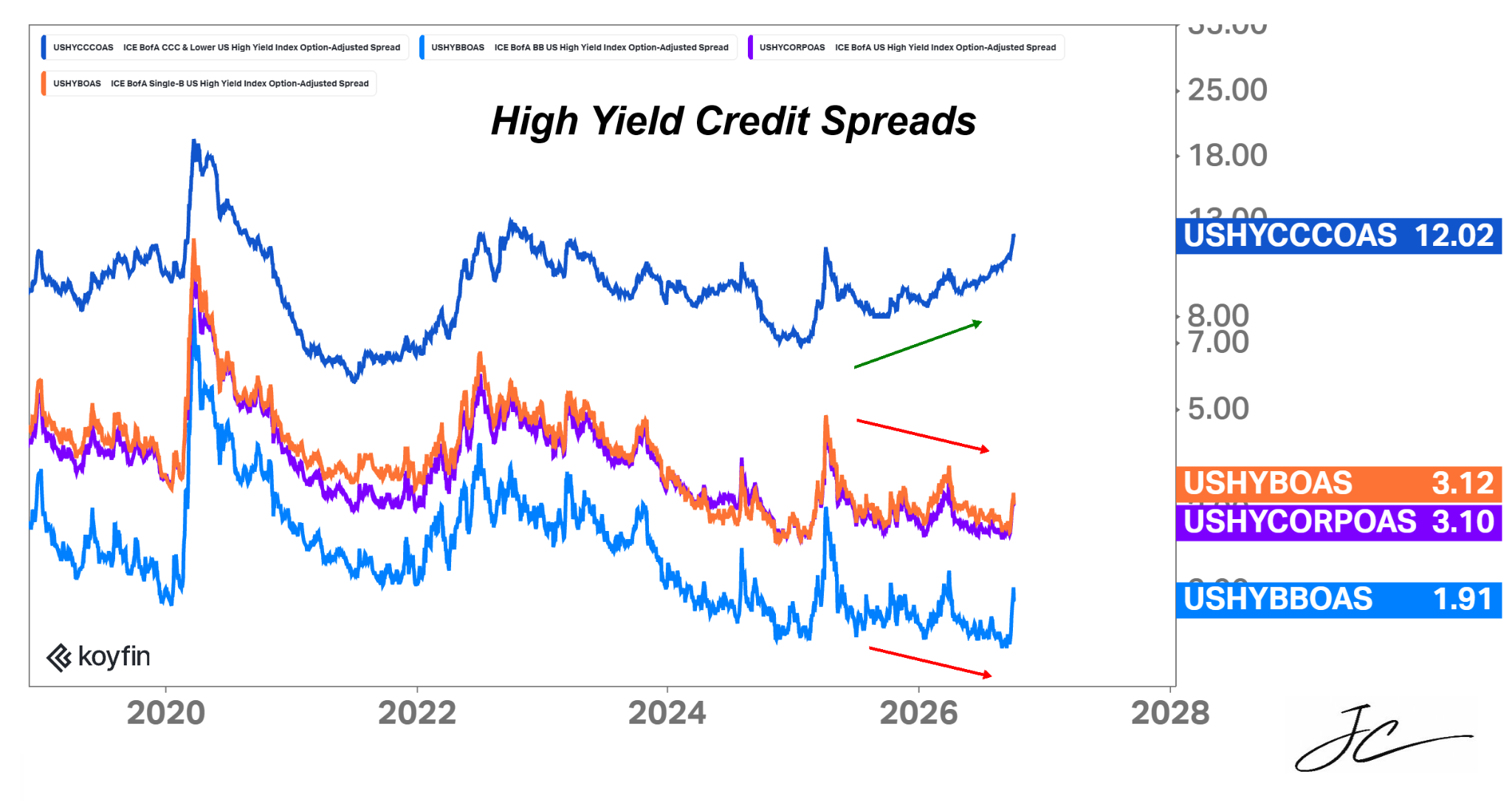
Every line on this chart represents the difference between the yield on a certain type of high-yield bond compared to the yield on risk-free US Treasuries.
If the bond market were truly freaking out right now, all of these lines would be going up because bond investors would be demanding more yield to take on the risk of owning high-yield bonds.
But they aren’t. Only one—the dark blue line comparing CCC-rated bonds to US Treasuries—is actually rising in any meaningful way.
CCC bonds are the worst of the worst. In JC’s words, they’re “like loaning your brother-in-law who owes everybody in town money and is unemployed."
But the CCCs are a tiny slice of the market, about $150 billion out of roughly $2.3 trillion in junk bonds (not to mention the ~$150 trillion overall bond market).
As Strazza put it, "Bond market people are basically saying nothing to see here. These are just some bad apples." The rest of the junk bond market is fine.
When I asked JC why I should care about any of this, here’s what he said:
"Because if there's problems in the stock market, mathematically, you have to see it in credit. You're not gonna get a complete collapse in the stock market, and everything's gonna fall apart like they keep promising us, and credit spreads remain tight."
So the next time someone tells you the whole market is about to fall apart, check the credit spreads first.
Right now, the trouble is mostly the drunk brother-in-law of the bond market.
There's plenty more on the replay, including a potentially very bearish tech chart, Mary's favorite stock ideas from our Portfolio Accelerator event last week, and why I was shaking my fist at the WSJ today.
– Spencer
Questions and answers
#From the October 7, 2026 Daily Rundown.
What are credit spreads measuring in the chart Spencer discusses?
They compare the yield on riskier corporate bonds with the yield on U.S. Treasuries. A widening spread shows investors demanding more compensation for that additional risk. The issue compares several credit-quality groups instead of treating every high-yield borrower as identical.
Why didn't JC interpret the chart as broad credit-market distress?
In the October 7 snapshot, the substantial widening was concentrated in CCC-rated bonds, a small part of the market discussed. Other high-yield groups were not showing the same move. His focus was whether trouble would spread, rather than assuming the weakest borrowers represented the whole market.
Originally published by Spencer Israel.